
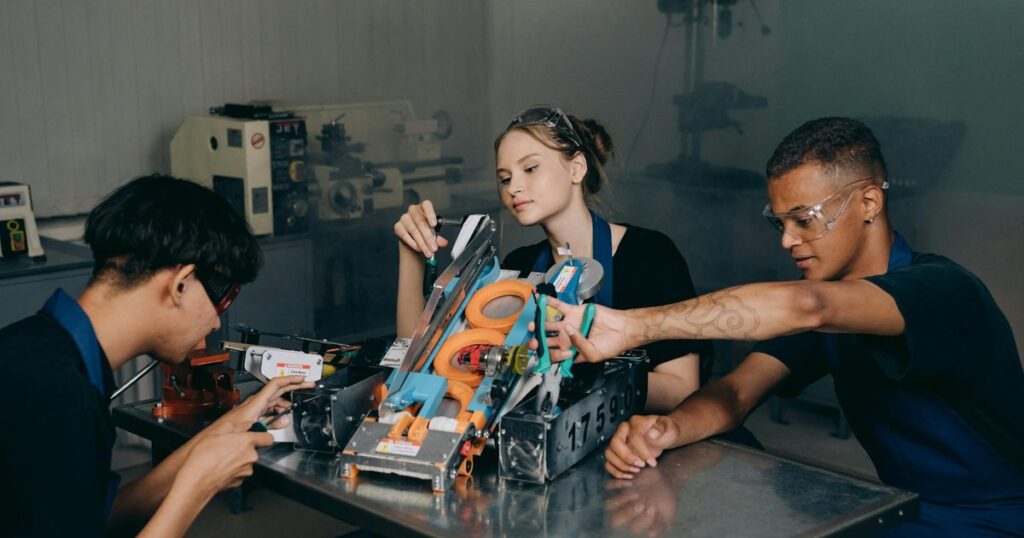
The OpenClaw ecosystem is more than a collection of tools; it’s a living, breathing community of developers, tinkerers, and visionaries. While the agent-centric and local-first AI principles provide the architectural bedrock, it is the community that breathes life into them, exploring uncharted territories and redefining what’s possible. This community spotlight delves into the ingenious ways developers are leveraging OpenClaw’s core philosophy to push boundaries, solve unique problems, and pioneer new agent patterns.
Beyond the Basics: Redefining Agent Autonomy
The classic paradigm of a single AI assistant answering questions is rapidly evolving within the OpenClaw community. Developers are architecting multi-agent systems where specialized OpenClaw Core agents collaborate, debate, and execute complex workflows autonomously. This isn’t just automation; it’s the creation of digital teams.

Case Study: The Self-Refining Research Agent
One developer shared a system built for academic research. It consists of three specialized agents: a “Curator” that scours local document repositories and trusted web sources, an “Analyst” that critiques and synthesizes the findings, and a “Writer” that drafts summaries. The breakthrough was a feedback loop where the Analyst agent evaluates the Writer’s output against the original sources, prompting the Curator to seek clarifying information—all local-first, ensuring sensitive research data never leaves the user’s machine. This creates a self-improving cycle of research quality, a powerful demonstration of agent-centric collaboration.
The Emergence of Agent “Personas” and Specialization
Community members are moving beyond functional roles and experimenting with distinct agent personas. By tailoring system prompts and pairing them with specific Skills & Plugins, they create agents with unique behavioral traits. For instance:
- The Cautious Auditor: An agent persona designed to scrutinize code or financial projections with a pessimistic bias, actively seeking out edge cases and potential failures that a more optimistic agent might miss.
- The Creative Provocateur: This agent’s role is to challenge assumptions within a brainstorming session, using local LLM capabilities to generate unconventional ideas that break groupthink.
This personification allows for more nuanced and human-like interactions within automated workflows, making the agent-centric approach feel more like managing a diverse team than configuring software.
Local-First as a Catalyst for Innovation
The local-first AI mandate of OpenClaw is often mistakenly seen as a limitation. The community, however, treats it as its greatest catalyst for innovation. By removing reliance on cloud APIs, developers are forced—and empowered—to think differently about efficiency, data structuring, and capability.
Optimizing for Smaller, Specialized Models
Instead of chasing the largest possible local LLM, there’s a growing trend of using OpenClaw to orchestrate multiple smaller, fine-tuned models. One developer created a content moderation system for a private forum using a pipeline: a small, fast model performs initial sentiment and toxicity classification. Only flagged content is passed to a more capable (but slower) reasoning model for nuanced judgment. This “triage” system, managed by an OpenClaw agent, dramatically reduces computational load and increases response speed, a practical solution born from local-first constraints.
Private Data as a Foundational Layer
The community is pioneering methods to deeply integrate personal and proprietary data into agent reasoning. This goes beyond simple RAG (Retrieval-Augmented Generation). Developers are building agents that use local databases, calendar entries, email archives, and project management tools as a dynamic memory core. One showcased Integration involves an agent that prepares for a user’s meetings by autonomously reviewing the day’s calendar, reading relevant project documents from a local NAS, and summarizing key discussion points and action items from previous meetings—all before the user has had their first coffee. The agent acts as a true extension of the user’s own memory and preparation habits.
Bridging the Digital and Physical Worlds
Perhaps the most exciting frontier is the community’s work in using OpenClaw agents as the “brain” for real-world actions. Through custom Skills & Plugins and Integrations, agents are stepping off the screen.

Home Automation with Contextual Awareness
While smart home automation exists, it’s typically reactive. An OpenClaw developer built an agent system that adds proactive, contextual awareness. By integrating with local weather data, calendar appointments, and even real-time energy pricing APIs (with all data processed local-first), the agent doesn’t just turn on lights at sunset. It might pre-heat the home office earlier on a cold morning before a busy meeting day, or suggest delaying running the dishwasher until off-peak energy hours, explaining its reasoning through a natural language interface.
DIY Robotics and Prototyping
In maker spaces and labs, OpenClaw is becoming a popular controller for prototypes. One project detailed an agent that monitors a 3D printer’s webcam feed via a local vision model. The agent can detect print failures like spaghetti, pause the print, and send an alert. Another integrates with simple robotic arms via USB, where the agent uses a local vision model to identify objects on a desk and can be tasked with physically organizing them. These projects exemplify the agent-centric ideal: a reasoning entity that perceives and acts upon its environment.
The Open-Claw Toolbox: Community Contributions Fueling Growth
This explosion of creativity is fueled by a virtuous cycle of sharing. The community actively contributes back to the ecosystem, expanding the possibilities for everyone.
- Niche Skills & Plugins: From agents that can interact with legacy desktop software via GUI automation to plugins for specialized data analysis packages, community contributions are filling gaps and enabling new use cases.
- Agent Pattern Repositories: Developers are sharing not just code, but blueprints. These “patterns”—like the multi-agent researcher or the cautious auditor—provide templates that others can adapt, accelerating development.
- Optimization Guides: Detailed tutorials on model quantization, efficient prompt design for smaller local LLMs, and hardware configuration help lower the barrier to entry and maximize performance.
Conclusion: The Future is Built by the Community
The stories emerging from the OpenClaw community vividly illustrate that the platform’s agent-centric and local-first AI principles are not endpoints, but a starting point for a new wave of computing. Developers are not merely using OpenClaw; they are extending its philosophy into domains as diverse as academic research, home automation, and physical robotics. They are proving that autonomy, privacy, and powerful reasoning can coexist, and that the most innovative applications often arise from treating constraints as creative challenges. As the toolbox of OpenClaw Core, Skills & Plugins, and shared agent patterns grows richer, one thing is clear: the future of personal, powerful, and private AI is being actively built, one community contribution at a time.