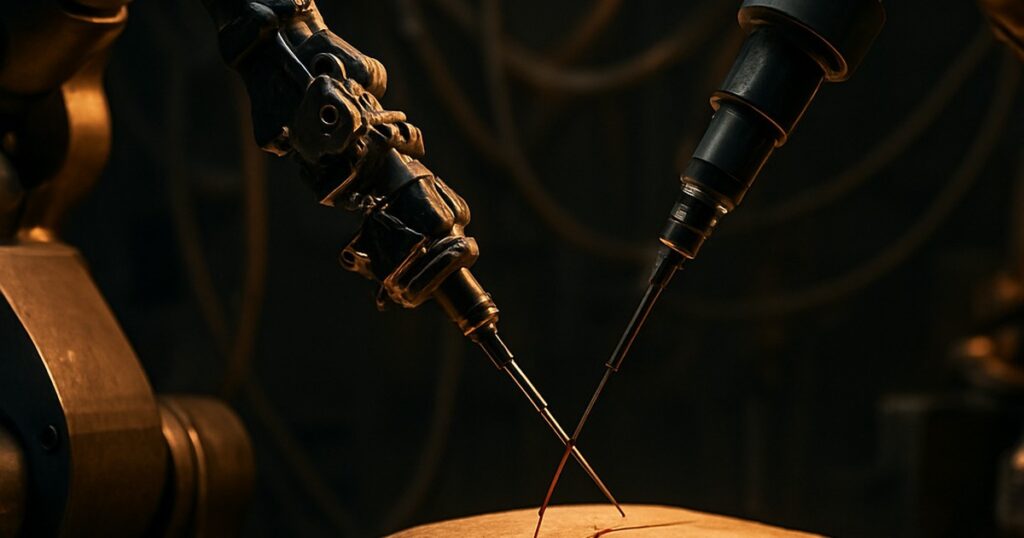
This week, the intersection of artificial intelligence and surgical robotics took a groundbreaking leap forward. A collaboration between Johns Hopkins University and Stanford University has resulted in the first successful integration of a vision-language model (VLM) with the da Vinci robotic surgical system. This innovation allows the system to autonomously perform complex surgical sub-tasks, such as suturing, under the vigilant watch of a human surgeon. The model was fine-tuned using 20 hours of video footage captured by surgeons operating the da Vinci robot, combined with synchronized kinematic data. The results are impressive: the robotic system was able to handle needles with a 95% success rate, place sutures with 91% accuracy, and tie knots with 87% precision. This remarkable achievement positions the da Vinci system not just as a tool under human control, but as a semi-autonomous partner capable of proposing and executing its own motions, while always under human supervision. This article will delve into the implications of this development, exploring how it may transform surgical procedures, the broader impact on robotic automation, and the challenges that lie ahead for clinical deployment.
Context
The da Vinci Surgical System, developed by Intuitive Surgical, has long been at the forefront of minimally invasive surgical techniques. Leveraging high-definition 3D vision and precise small-incision capabilities, it has revolutionized surgeries by enhancing dexterity and precision. However, until now, the system has functioned strictly under teleoperation, with surgeons manipulating robotic arms from a console. The integration of AI into this system represents a significant paradigm shift — one that has been in the works for several years as advances in machine learning and computer vision have made such innovations conceivable.
This week’s announcement comes as part of a broader trend in the AI and robotics industries, where vision-language models are increasingly applied to real-world tasks. These models, which learn by pairing visual inputs with textual descriptions, have demonstrated potential across various domains, including autonomous vehicles and industrial robotics. The application of VLMs in surgical robotics, however, introduces a unique set of challenges and opportunities, as it involves human life and the complex, nuanced environment of the operating room.

The timing of this development is crucial, as healthcare systems worldwide are grappling with workforce shortages and increasing demand for surgeries. By enabling robotic systems to perform routine tasks autonomously, surgeons could be freed to focus on more complex aspects of procedures, potentially reducing time-per-operation and mitigating the risk of surgeon fatigue. This initiative, therefore, not only addresses technological advancements but also responds to pressing operational needs in modern healthcare.
Autonomous Suturing: A Milestone in Surgical Robotics
The core breakthrough achieved by the Johns Hopkins-Stanford team lies in the autonomous execution of surgical sub-tasks by the da Vinci system. Using a newly developed vision-language model, the system was trained on a dataset comprising 20 hours of surgical video recordings. These recordings captured real-life procedures performed by expert surgeons, paired with corresponding kinematic data that details the precise movements and forces applied during these tasks.
In practice, this model operates under a supervised-autonomy framework. The surgeon remains at the console, not as a passive observer, but as an active supervisor who approves each sub-task proposed by the robot. This approach ensures that human expertise remains central to the surgical process, while also leveraging the robot’s capacity for precise, repetitive motion — a combination that could redefine efficiency in the operating room.
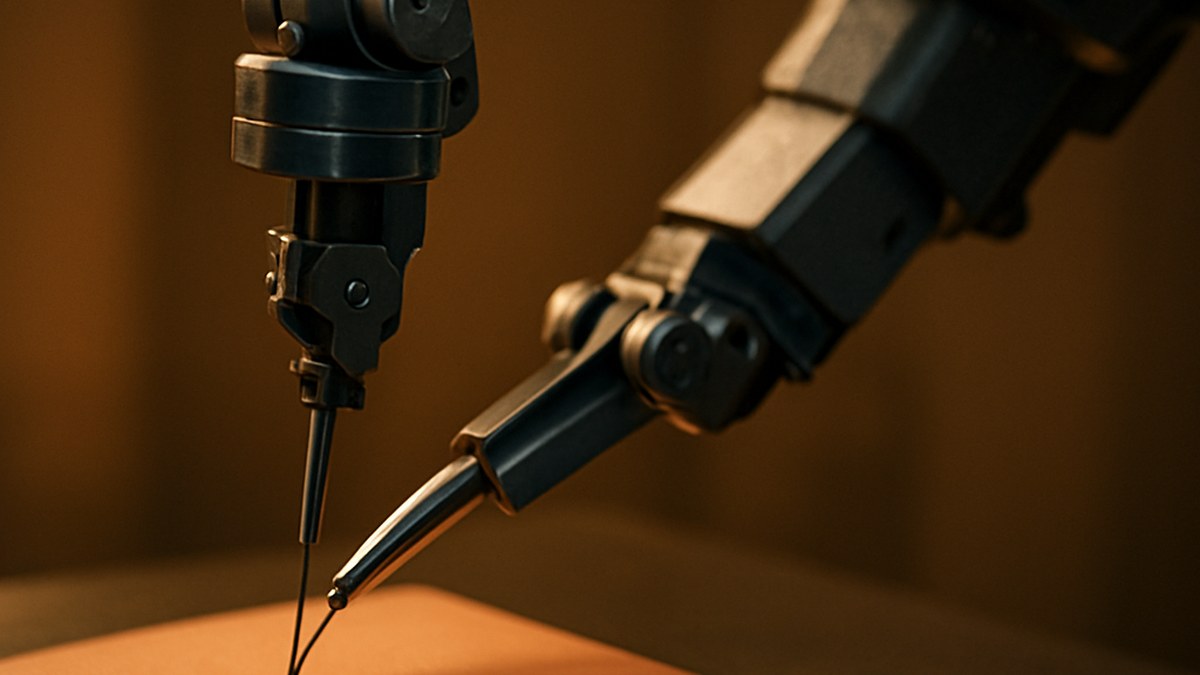
The success rates achieved by the model are remarkable: needle handling reached a 95% completion rate, suture placement 91%, and knot tying 87%. These metrics were benchmarked using tissue phantoms, which simulate the mechanical properties of human tissue. This validation step is crucial as it ensures that the robot can adapt to the variability inherent in human anatomy, a critical factor for real-world clinical application. Despite these successes, Intuitive Surgical, the maker of the da Vinci system, has emphasized that FDA clearance for clinical deployment remains a separate step, underscoring the careful, incremental approach being taken towards integrating AI into surgical practice.
Why It Matters
The implications of this development extend far beyond the realm of surgery. The introduction of vision-language models into robotic systems signifies a step towards a unified layer of foundational AI models applicable across various robotic verticals. This trend is mirrored in other sectors, such as industrial robotics, where companies like Atlas and Gemini Robotics are pioneering similar approaches for skill transfer in humanoid robots.
For the healthcare industry, the potential benefits are profound. Autonomously performing routine surgical tasks could alleviate some of the workload on surgeons, leading to reduced procedure times and potentially improved patient outcomes. By minimizing the physical strain on surgeons, this technology could also reduce the incidence of errors associated with fatigue, enhancing the overall quality of care delivered in surgical settings.
Moreover, the economic impact is non-trivial. With the ability to execute high-volume procedures more efficiently, hospitals could see a decrease in operational costs, thereby making healthcare more accessible and affordable. This innovation also positions the healthcare sector as a leading adopter of advanced AI technologies, which could spur further investment and innovation across related fields.
How We Approached This
In crafting this article, we drew upon a variety of authoritative sources, including the original research publication from Johns Hopkins and Stanford. Our editorial lens at Agent Runtime emphasizes the agent-centric perspective, particularly in the context of local-first AI, which prioritizes human oversight and collaboration with autonomous systems.
We selected to highlight the specific success rates of the surgical tasks and the broader implications for the healthcare industry, while intentionally omitting technical jargon that might obscure the core message for our readership. Our focus remained on the potential transformative effects of this innovation within the operating room and beyond, aligning with our publication’s mission to explore the future of intelligent agent patterns and their impact on society.
Frequently Asked Questions
What is a vision-language model (VLM)?
A vision-language model (VLM) is a type of artificial intelligence that learns to understand and generate language from visual inputs. It combines visual data, like images or videos, with textual data to perform complex tasks, offering a way to train robots to understand and interact with the world in a more human-like manner.
How does the da Vinci system ensure surgical safety?
The da Vinci system ensures safety through a supervised-autonomy framework, where a human surgeon remains in control. While the robot proposes and performs tasks, the surgeon oversees the process, approving each action. This setup leverages the precision of robotic movement while maintaining human expertise, ensuring high standards of surgical safety and efficacy.
Will this technology affect the cost of surgeries?
Potentially, yes. By increasing the efficiency of routine procedures, this technology could reduce operational costs, leading to more affordable surgeries. Faster procedure times and reduced surgeon fatigue may also improve outcomes, which in turn could lower overall healthcare costs by minimizing the need for corrective surgeries and associated complications.
Looking ahead, the integration of vision-language models with surgical robots like the da Vinci system represents a critical advance in the evolution of medical technology. As these systems evolve, they promise to not only enhance surgical efficiency but also inspire broader applications of AI in healthcare and beyond, paving the way for a future where human-robot collaboration becomes the norm in various facets of life.