

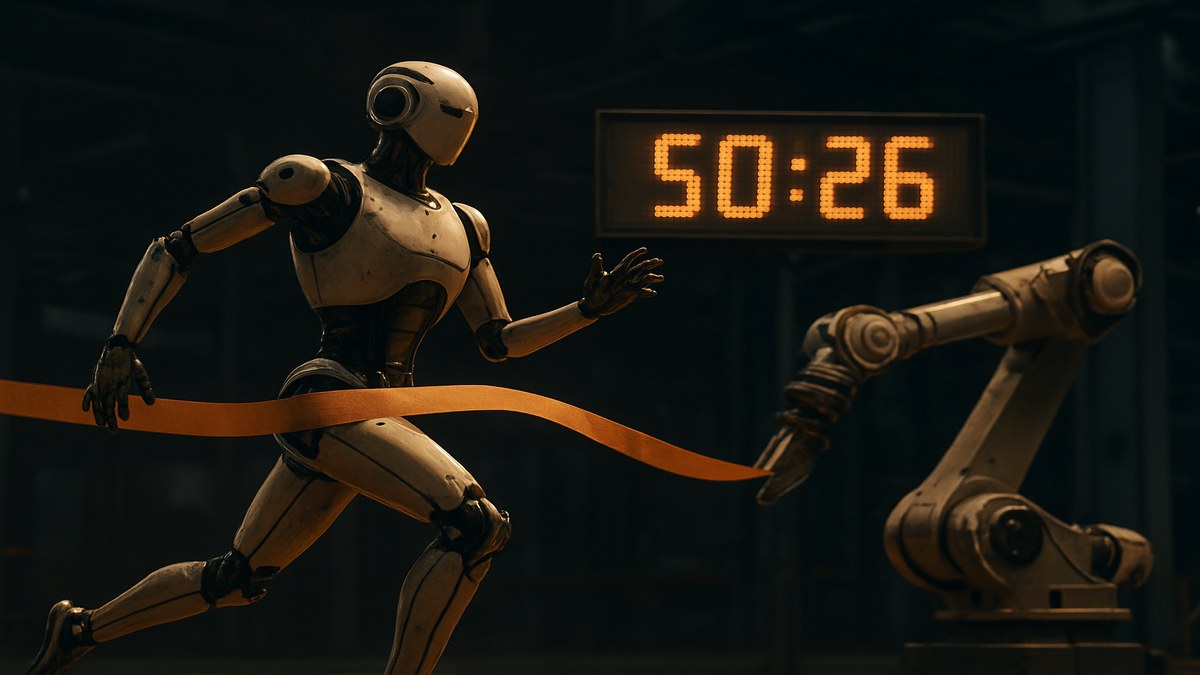
In a thrilling demonstration of the advancing capabilities of robotics technology, the world witnessed an unprecedented event today: the inaugural humanoid robot half-marathon held in Beijing E-Town. The race saw Honor’s autonomous navigation robot clinching the championship with a remarkable net time of 50 minutes and 26 seconds, effectively beating the human world record of 57 minutes and 20 seconds set by Ugandan runner Jacob Kiplimo. This event not only showcased the sophisticated engineering behind modern robots but also highlighted the potential of artificial intelligence in surpassing human athletic benchmarks. This article explores the significance of this achievement, the entities involved, and its implications for the future of robotics and AI development.
Context
The Beijing humanoid robot half-marathon represents a pivotal moment in the evolution of robotics. As the first of its kind, this race was designed to push the boundaries of what humanoid robots can achieve in terms of speed, endurance, and autonomy. The event was organized by the Beijing E-Town’s Robotics Development Center, in collaboration with several major technology firms, including Honor, the Chinese tech giant known for its innovations in AI and robotic systems. The timing of this event is particularly significant, as it coincides with a growing global interest in autonomous systems and their applications in various sectors, from logistics to healthcare.
Honor, already a dominant player in AI technology, leveraged its expertise to design robots capable of navigating complex environments autonomously while maintaining high energy efficiency and speed. The company’s proprietary algorithms and advanced sensor technologies were crucial in enabling the robots to learn and adapt to the dynamic conditions of the marathon. This competition also attracted international attention, with teams from Germany, France, and Brazil participating, highlighting the global competitiveness and collaborative spirit in the field of robotics.
Prior to this event, humanoid robots were primarily tested in controlled environments or used for specific tasks such as manufacturing or assistance in healthcare settings. The half-marathon marks a significant departure from these traditional applications, showcasing the potential of humanoid robots in dynamic, real-world scenarios. It also sets the stage for future events that could further accelerate research and development in this area. The data collected from this event is expected to provide invaluable insights into bipedal locomotion and contribute to the broader understanding of robotic movement and efficiency.
What Happened
The race commenced early in the morning under clear skies, with a record 112 teams participating. The course, meticulously designed to test the robots’ endurance and agility, wound through the streets of Beijing E-Town, presenting a series of challenges that included varying terrains and obstacles. Honor’s autonomous robot emerged victorious, clocking in a net time of 50 minutes and 26 seconds, a stark contrast to the human world record held by Jacob Kiplimo. This performance was further underscored by the unique scoring system, which applied a weighted coefficient of 1.0 to fully autonomous robots and 1.2 to remotely controlled ones.
The race also saw the participation of ‘Lightning’, a remotely controlled robot from Honor, which finished first across the line with a time of 48 minutes and 19 seconds. However, due to the coefficient adjustment, the autonomous robot was declared the overall winner. The runners-up, also from Honor, finished with times of 51 and 53 minutes, respectively, showcasing the consistent high performance of the company’s robotics team. The event was not just a competition among engineering marvels but also a testament to the rigorous training and programming that these machines undergo.

In addition to the excitement of the race itself, the event was marked by its potential to generate one of the most comprehensive datasets on outdoor bipedal locomotion ever collected. This dataset, which will include metrics on timing, gait efficiency, energy consumption, and fall recovery, is slated for public release within the next 30 days. Such data is anticipated to fuel further advancements in robotics research, providing a valuable resource for engineers and scientists looking to refine robotic motion and energy efficiency.
Why It Matters
The implications of this historic event extend far beyond the boundaries of competitive robotics. The successful completion of the humanoid robot half-marathon signifies a breakthrough in the capabilities of autonomous systems, opening up new possibilities for their application across various industries. For instance, the advancements in energy efficiency and autonomous navigation demonstrated by Honor’s robots could inform the development of more effective logistics systems, where robots are required to operate independently over extended periods.
Moreover, the insights gained from the event could catalyze innovations in assistive technologies. By improving the agility and adaptability of humanoid robots, companies could develop more advanced robotic assistants capable of performing complex tasks in healthcare, elder care, and rehabilitation settings. This could lead to improved quality of life for individuals requiring assistance and reduced burdens on human caregivers.
Furthermore, the open dissemination of the race data will foster greater collaboration and innovation within the robotics community. By providing access to the extensive dataset generated from the marathon, researchers and developers will be able to test new algorithms, refine existing models, and explore novel approaches to robotic locomotion and control. This could accelerate the pace of innovation in the field, leading to more robust and capable autonomous systems in the future.
How We Approached This
In crafting this article, we at Agent Runtime prioritized a comprehensive analysis of the event and its broader implications. Our editorial approach focused on presenting a balanced view that celebrates technological progress while critically examining its impact. We sourced information from event organizers, participating teams, and industry experts to provide a well-rounded perspective on the race and its significance.
Our commitment to an agent-centric, local-first AI perspective guided our emphasis on the achievements of Honor and other domestic entities involved. We opted to highlight the potential benefits of this technological advancement, considering the local context and the role of Chinese companies in driving global innovation in AI and robotics. By focusing on the intersection of technology, industry, and society, we aim to deliver insightful analysis that resonates with our readership.
Frequently Asked Questions
What are the key differences between autonomous and remotely controlled robots?
Autonomous robots are designed to operate independently using pre-programmed algorithms and real-time sensor data to navigate their environments. In contrast, remotely controlled robots rely on human operators to guide their actions, often using a combination of live video feeds and manual input. The Beijing half-marathon applied different scoring coefficients to these categories, emphasizing the higher challenge of autonomous operation.
How will the data collected from this event be used?
The dataset from the marathon will be released as an open resource for researchers and developers. It will include detailed information on timing, gait efficiency, energy use, and fall recovery metrics. These insights are expected to advance the state of research in humanoid robotics, aiding in the development of more efficient and adaptable robots for various applications.
What are the future prospects for humanoid robots in real-world applications?
Humanoid robots have the potential to transform industries such as logistics, healthcare, and personal assistance. By enhancing their autonomy and efficiency, these robots could perform tasks traditionally done by humans, leading to increased productivity and reduced human workload. The Beijing race is a step forward in realizing these possibilities, showcasing their capabilities in dynamic environments.
The Beijing humanoid robot half-marathon marks a defining moment in the evolution of robotic technology, illustrating the remarkable progress being made in autonomous systems. This event not only sets new benchmarks for performance but also paves the way for future innovations that could revolutionize various industries. As the robotics community eagerly anticipates the release of the marathon data, the potential for developing even more advanced humanoid robots remains vast and promising. The success of Honor’s robots underscores the transformative power of artificial intelligence and serves as a reminder of the relentless pursuit of excellence that drives technological advancement.